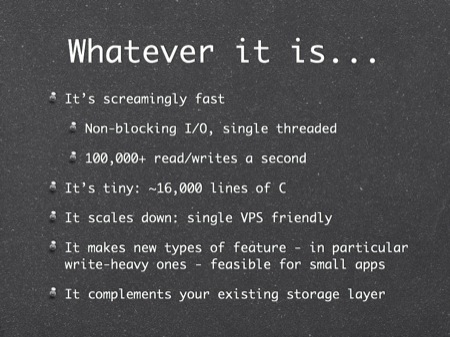
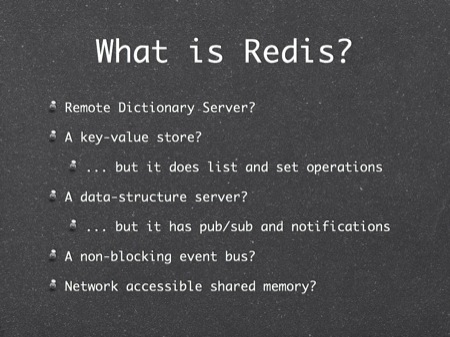
Redis is an advanced key-value store. It is similar to memcached but the dataset is not volatile, and values can be strings, exactly like in memcached, but also lists, sets, and ordered sets. All this data types can be manipulated with atomic operations to push/pop elements, add/remove elements, perform server side union, intersection, difference between sets, and so forth. Redis supports different kind of sorting abilities.
In order to be very fast but at the same time persistent the whole dataset is taken in memory, and from time to time saved on disc asynchronously (semi persistent mode) or alternatively every change is written into an append only file (fully persistent mode). Redis is able to rebuild the append only file in background when it gets too big.
Follow more :->
Whats new on Redis 2.0
Tutorial on redis
Friday, September 3, 2010
Tuesday, February 9, 2010
Eugene Letuchy (a Facebook Engineer) talks about Facebook Chat
"One of the things I like most about working at Facebook is the ability to launch products that are (almost) immediately used by millions of people. Unlike a three-guys-in-a-garage startup, we don't have the luxury of scaling out infrastructure to keep pace with user growth; when your feature's userbase will go from 0 to 70 million practically overnight, scalability has to be baked in from the start. The project I'm currently working on, Facebook Chat, offered a nice set of software engineering challenges:"
Here is the original post by Eugine
http://www.facebook.com/note.php?note_id=14218138919
- Real-time presence notification
- Real-time messaging
- Distribution, Isolation, and Failover
- Glueing with Thrift
Here is the original post by Eugine
http://www.facebook.com/note.php?note_id=14218138919
Ever wondered how Gmail/Facebook chat works?
Web based IM clients are seem to be the flavour of the month at the moment. Gmail has had one for a little while now and more recently Facebook has added this to their already impressive stable of features. These are really cool, and rip all over the old form based chat rooms, but how do they do it without using any plugins, flash or the dreaded ActiveX componets?
Interested in finding details? k. Here where to find more...
http://technophiliac.wordpress.com/2008/05/28/ever-wondered-how-gmailfacebook-chat-works/
Interested in finding details? k. Here where to find more...
http://technophiliac.wordpress.com/2008/05/28/ever-wondered-how-gmailfacebook-chat-works/
Subscribe to:
Comments (Atom)